
NATO 3.0 kan alleen gebouwd worden met een Europese Defensie-unie
6 juli 2026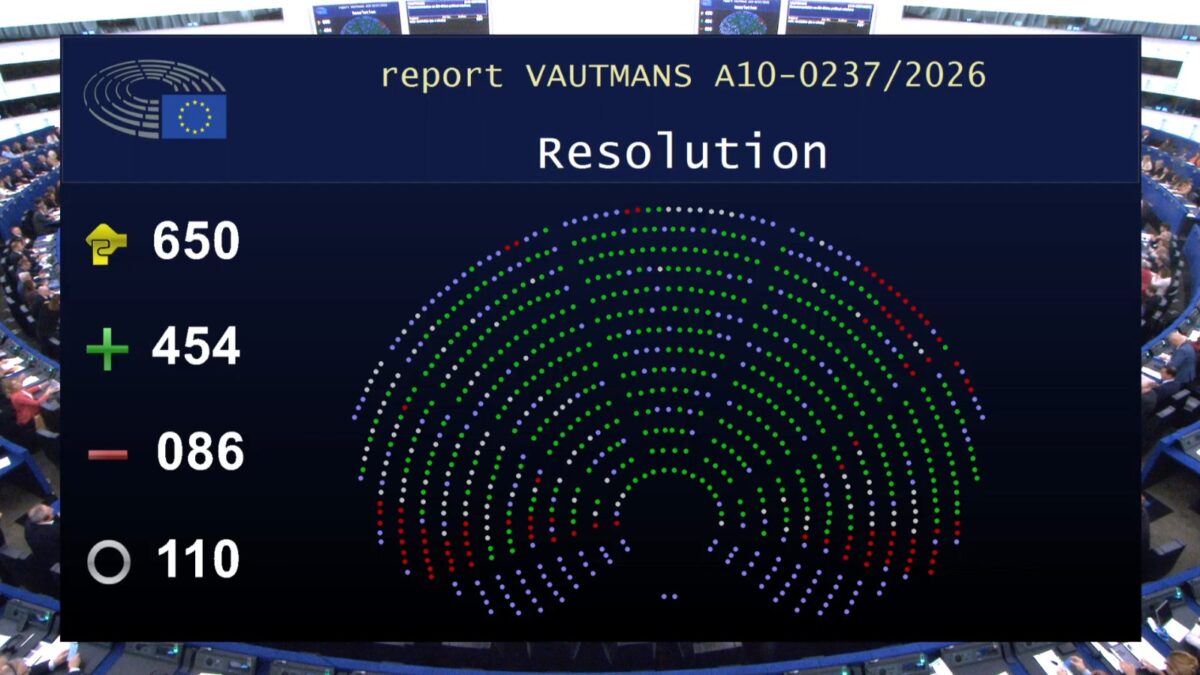
STRASBOURG – The European Parliament today approved the China report by Member of the European Parliament Hilde Vautmans (Anders, Renew Europe), with 454 votes in favour, 86 against and 110 abstentions. Parliament is calling on Europe to take tougher action against Chinese dumping, espionage and unfair competition, as well as against Chinese companies helping to sustain Russia’s war machine. As rapporteur, Vautmans led the negotiations between the political groups.
Europe’s trade deficit with China has risen to around €360 billion a year, almost €1 billion a day. Chinese companies enjoy free access to the European market, while European companies do not enjoy the same access in China. The report calls on Europe to use its trade instruments for as long as China fails to open its market, to reduce its dependence on China for rare earths, medicines, batteries and semiconductors, and to keep products made with forced labour off the European market.
“A large share of the cheap parcels from Temu and Shein enter our country through Liège Airport,” says Hilde Vautmans. “A Belgian retailer that complies with all our rules has to compete with products that do not. Anyone who wants access to our market must play by the same rules as our companies.”
“Anyone who helps Putin’s war machine must pay a price.” – Hilde Vautmans
No paper tigers
According to Vautmans, Europe does not need to invent new instruments to achieve this. Since 2024, Chinese electric vehicles have faced additional import duties because they benefit from unfair state subsidies. That same year, a Chinese train manufacturer withdrew from a public procurement procedure in Bulgaria after the European Commission opened an investigation into the subsidies it had received. And since last year, Europe has restricted Chinese companies’ access to major public procurement contracts for medical devices because China keeps its own market closed to European companies.
“The instruments exist and they work, if we are willing to use them,” Vautmans continues. “What we are asking is that they become the rule rather than the exception. And some of them need to take effect faster. Europe’s ban on products made with forced labour has been adopted, but it will only apply from the end of 2027. That needs to happen sooner.”
No espionage, no silence
Parliament is calling for stricter scrutiny of Chinese investments in ports, energy grids, telecommunications and critical raw materials, stronger protection against espionage, and greater attention to the data collected by Chinese electric vehicles and apps such as TikTok. Chinese companies supplying Russia with goods for its war against Ukraine should be added to the European sanctions list.
“Our country is a major hub, with our ports, Liège Airport and our energy networks. These are precisely the areas where we need much stricter scrutiny of who is investing and who may be gaining access to sensitive information,” Vautmans says. “We are not calling for a ban on TikTok, but European data must remain in Europe. And anyone who helps Putin’s war machine must pay a price.”
The report also opposes any attempt to change the status quo around Taiwan by force or coercion. “Taiwan may be on the other side of the world, but a crisis there would affect us directly,” says Hilde Vautmans. “Taiwan produces the vast majority of the world’s most advanced chips. They are in our cars, our smartphones and our medical equipment. In 2022, we were caught off guard by Russia’s invasion of Ukraine. We must not make that mistake a second time.”
The report is equally clear on human rights. It condemns repression in Xinjiang and Tibet, forced labour and the erosion of freedoms in Hong Kong. “Economic interests cannot buy our silence.”
“Beijing ignores twenty-seven voices. It cannot ignore one.” – Hilde Vautmans
From words to action
The vote comes at a pivotal moment. Trump and Xi spoke recently. Tomorrow, European Commissioner for Trade Maroš Šefčovič travels to Beijing. “He is leaving with a strong mandate from Parliament,” says Vautmans. “I expect concrete results: the trade deficit must come down, European companies must gain better access to the Chinese market, and Europe must be able to rely on critical raw materials without being exposed to political pressure. We cannot depend on a single country for rare earths, batteries and semiconductors. De-risking is not decoupling: we want trade with China, but on fair terms. Europe must remain open, but openness must not mean naivety. We want open markets, not open markets that result in European factories closing. This visit must deliver results.”
China will also be discussed at the European Council on 15 and 16 October, followed later this autumn by the strategic dialogue between Kaja Kallas and Wang Yi. “France and Germany are now also sounding the alarm together. In their letter to Commission President von der Leyen, Macron and Merz call for a stronger European response to trade imbalances, market distortions and our dangerous dependencies on China. I support that call, and it matters: Europe is increasingly moving in the same direction. In her State of the Union address, von der Leyen said that when dealing with China, Europe needs not only words but action. Today, Parliament has given her the list of actions.”
The report is not binding, but Parliament carries real weight. Every trade agreement requires its approval, and as co-legislator it helps decide on European trade instruments. “When China imposed sanctions on Members of the European Parliament in 2021, Parliament froze the investment agreement with China. It is still on ice today. Anyone negotiating with China on Europe’s behalf now knows where Parliament draws the line.”
One European course
“Beijing ignores twenty-seven voices. It cannot ignore one,” says Vautmans. “Not 27 different China strategies, but one European course. With a market of 450 million consumers, Europe has enormous economic power. We must have a seat at the table, not be on the menu.”